The Manager Who Wants the Answer Now — and Why That's Not (Entirely) Their Fault
- Alexander Martínez Kocmann

- Aug 23
- 2 min read
A former Ericsson colleague posted something recently that stuck with me: "The older I get, the more problems I have with the culture where every manager needs to know the answer to every question instantly." Fair point — and it's not just a personality thing. It's a genuinely recognised organisational pattern, and Customer Success feels it more than most.
There's real research behind it. A Vanson Bourne survey for Teradata found 74% of senior leaders think their own analytics are too complex, and 79% said they need more data than they currently have — and yet they keep asking for answers faster anyway. NewVantage Partners' long-running executive survey tells a similar story: most large companies still haven't built a properly data-driven culture, despite years of investment. The gap isn't ambition, or even tooling. It's fragmented data, unclear ownership, and metric definitions nobody quite agrees on.
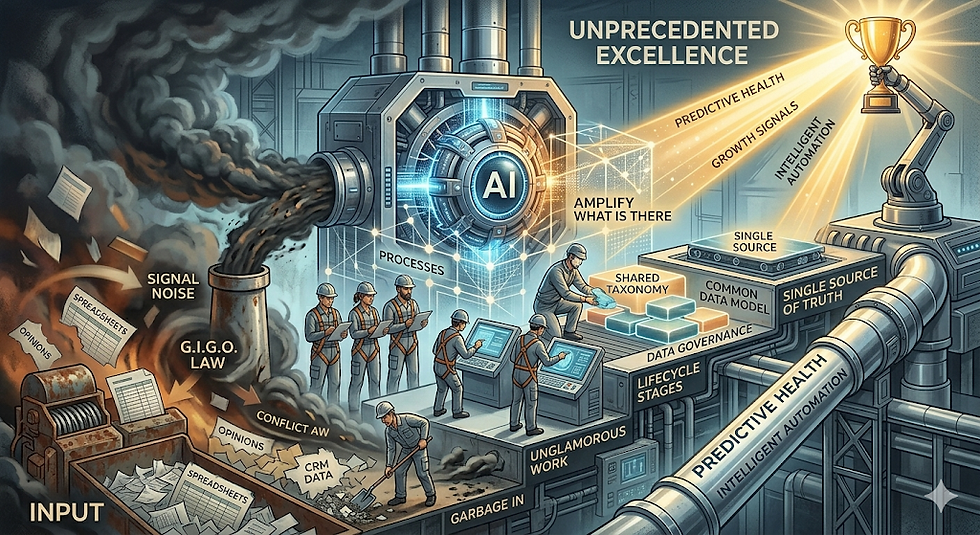
Consumer AI is making it worse. Ask ChatGPT anything and you get a fluent answer in seconds, so it's easy to assume the same should work inside the company. But an internal question is a different animal — a model has no idea what "healthy account" or "churn risk" means in your organisation specifically. Without governed definitions and clean data behind them, an instant answer can be fast, convincing, and wrong. There's also what people call the "ad hoc request trap": Data, RevOps, CS Ops and BI teams often get seen as middleware sitting between a manager and the answer, rather than as people building something with real constraints and lead times.
In Customer Success, this usually sounds like: "give me real-time churn risk, by segment, region and product, cross-referenced with sentiment." A fair question — but answering it properly needs a unified data model across CRM, usage, support and billing, an agreed definition of "risk," and often a predictive layer most CS orgs haven't finished building, if they've started at all.
The fix isn't to say no. It's to make the conversation decision-led: what decision are you actually making, by when, how much confidence do you need, what's the minimum reliable answer for right now, and what would need building for a fuller one later? Wharton's research on this is worth reading — start from the available data instead of the decision, and you'll likely end up answering the wrong question well.
A bit of honesty helps too. Something like "here's what we can tell you today, here's what we can't yet say reliably, and here's what we'd need to build to answer this properly" turns a demand into a real conversation — without lowering the bar for responsiveness.
Have you run into this at your own company — and how have you pushed back without just shutting the conversation down?